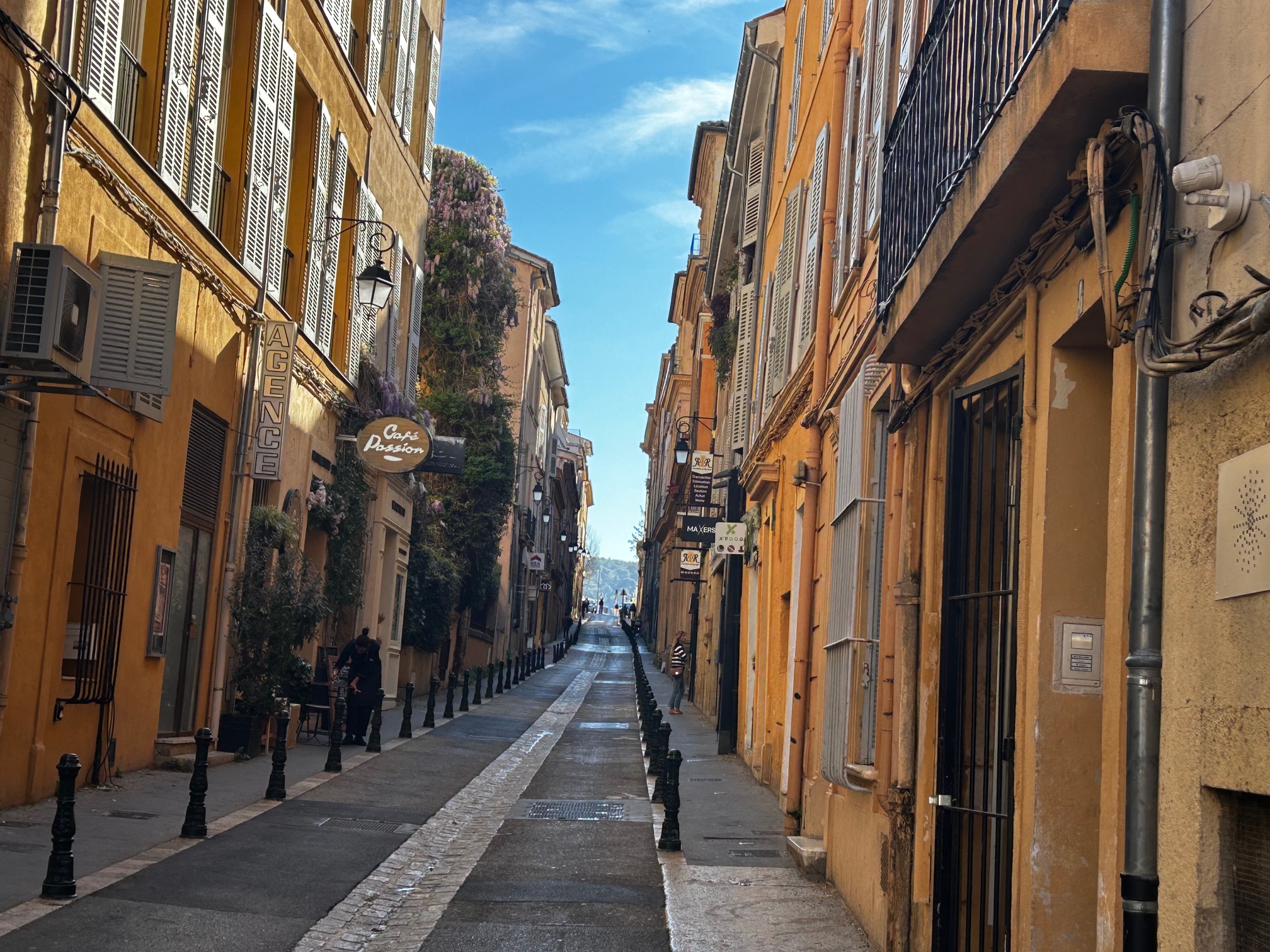
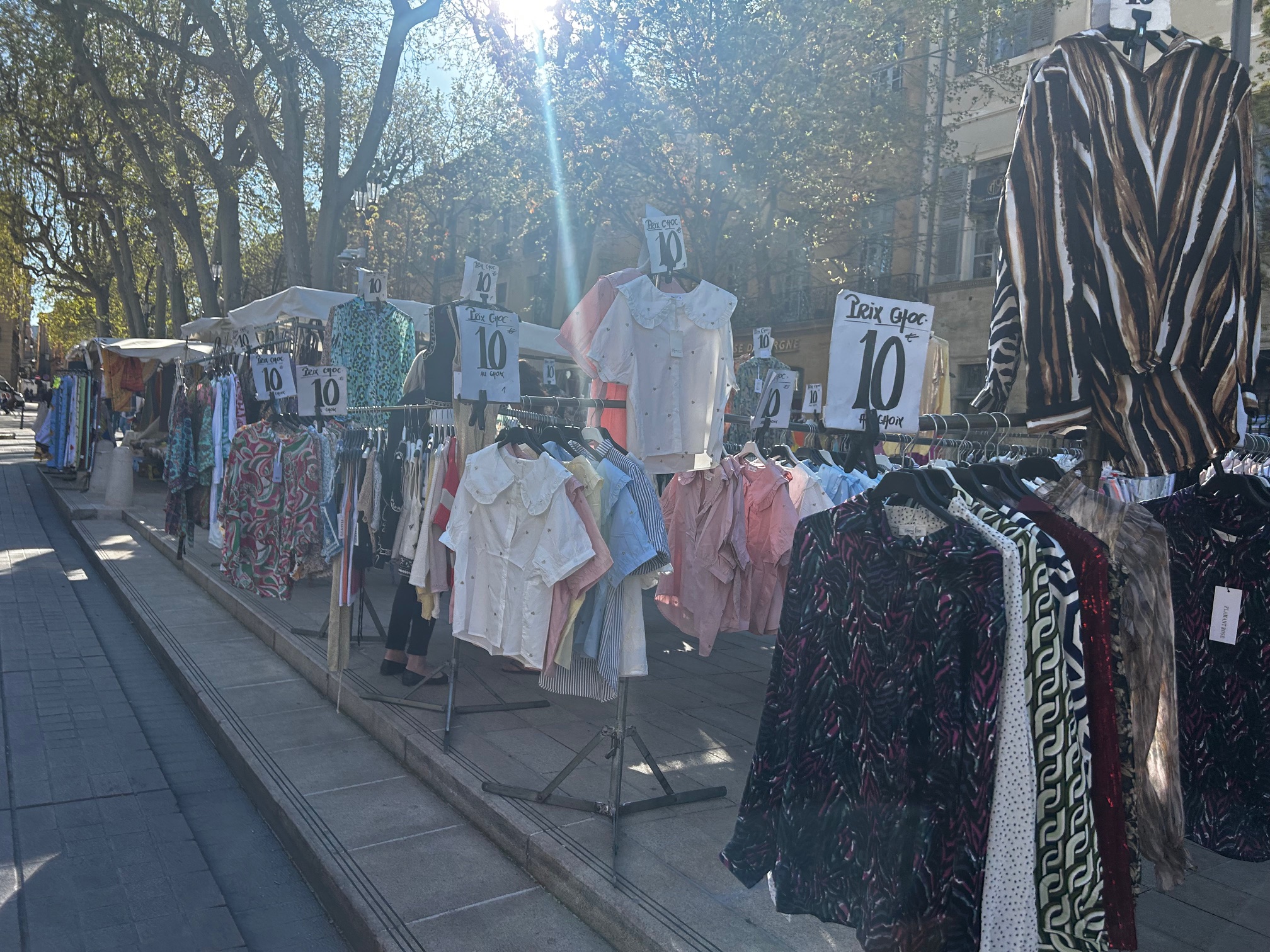
A typical street in Aix-en-ProvenceAlong Cours Mirabeau everything is 10 euros
After an overnight flight to London, four hours getting lost at Heathrow, a delayed trip to Marseille and a nearly missed late-night ride share, I have arrived in Aix-en-Provence.
Travel lowlight: A rude long haul, premium economy seat partner who immediately took off his shoes and stuck his bare foot in my space.
Travel highlight: Successfully communicating en francais (partially and tres rudimentary!) with three people while trying to navigate Marseille to Aix.
I slept fitfully, drank a cafe on my balcony overlooking the garden, enjoyed breakfast in the lobby and then set out for a stroll.
At 9 a.m. Aix is just beginning to awaken. Delivery drivers share narrow streets with pedestrians pulling their carts to the city’s many open air markets. On the Cours Mirabeau — a major street lined with clothing, jewelry, soap and tablecloth stalls — it seems everything costs 10 euros. Why did I worry about what to pack?
I am headed to the South of France for a six-week “Living and Learning” program through Road Scholar.
The program includes study of the French language, tours and cooking classes, as well as the opportunity to live in Aix-en-Provence like a local.
My group includes older adults, many of us single; all of us staying in the same “apart-hotel” for the duration. We have a group leader — Christopher Roche — who will help us acclimate. Christo is also an opera singer!
It’s been a life-long dream to live in France since studying the language in high school and college. This program was the best mix of a “living like a local” experience and a vacation.
How much do you pack for a 6-week international trip?
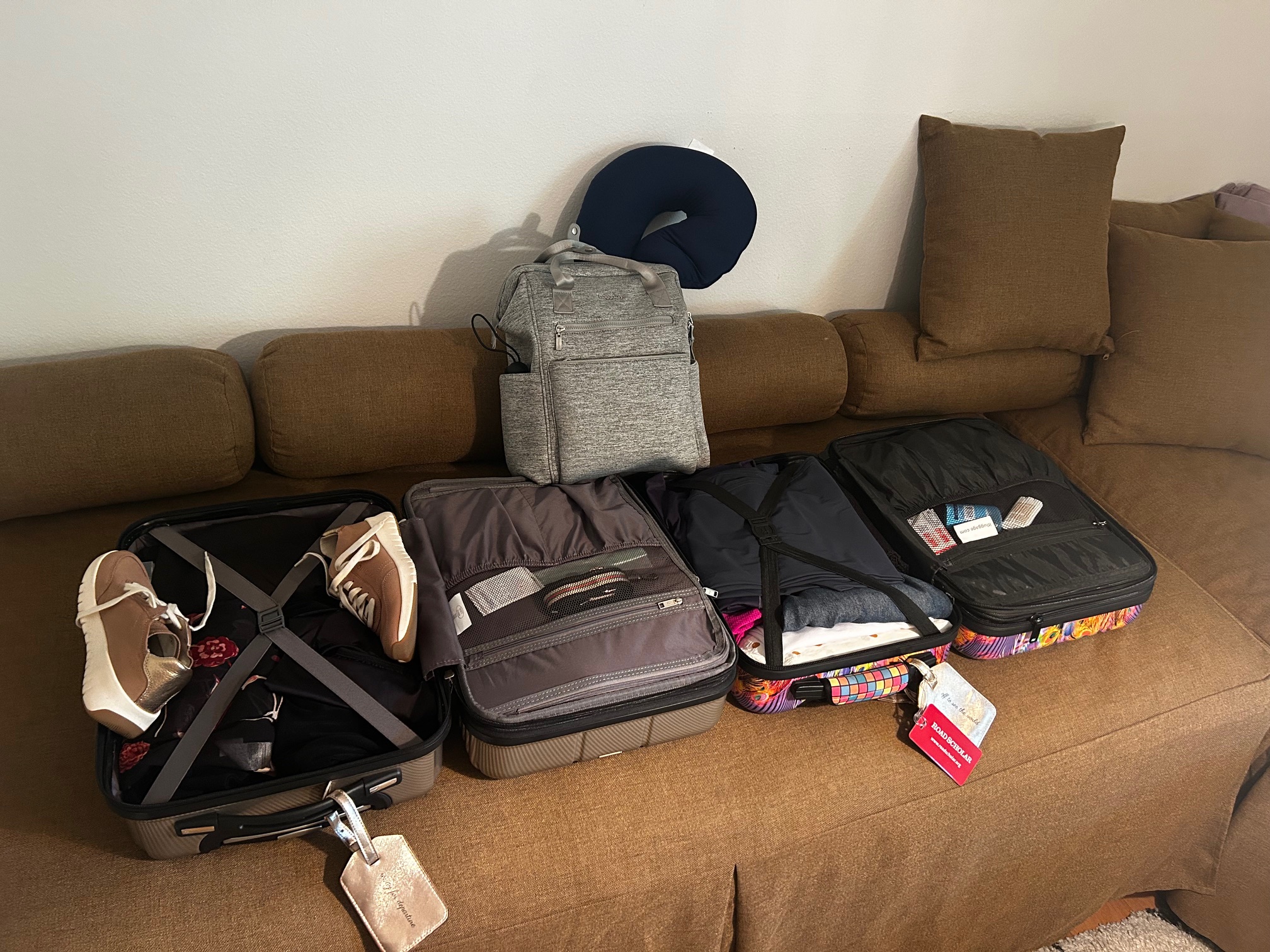
I decided on two small bags and a backpack. I’ll check one of the small roller bags and carry on the other. If British Air loses the checked bag, I still have stuff.
I set a deadline of April 1 — a week before departure — to be fully packed. Thus, I’m not stressed, and I’m more than ready to fly.
Ok Zuckerberg.
LOVE the new Subscribe feature. (I’m one of many, many who couldn’t seem to find the time to draw a ring around any Google+ circles.)
Not quite sure, however, if I’m comfortable having you and your Facebook minions determine exactly what constitutes a “Life Event” for me and my “friends.” So, I’ve been culling through my newsfeed x-ing out people right and left. When I click “Life Event,” what exactly happens? I mean, I’m not able to classify something as a “Life Event” when I post something. So, when my friend Flicka posts an update that includes the phrase ” . . . I want to really divorce myself from all things mundane . . .” are you actually parsing the status and deciding to show me this one from Flicka? Or, are you only going to show me her status when Flicka changes her profile to “In a relationship . . . with Golden Retrievers?!”
Please explain.
In the same way Google uses page rank to determine what shows up in your search results, Facebook uses something called an edge rank to determine what shows up in your newsfeed.
Whenever anyone interacts with any object in your newsfeed, Facebook creates an “edge.” The ranking of this edge is broken down into three parts: affinity (how often your posts are LIKED or commented on), weight (videos are best, pictures are better, text is plain boring) and age (the more recent, the better.)
So, here’s how to get a higher edge rank and have your posts show up more often on your friends’ feeds (and you thought the popularity contest was over in high school!):
Don’t simply STALK (Hilary! and Eve!). Commenting and Liking is what increases your affinity. If you’re interested in seeing someone’s status more, go to her page and comment on some of her stuff. Don’t just sit around waiting for Facebook to serve up something in your feed.
Comment on your friends’ comments one at a time. Each comment increases your edge rank. Don’t wait to consolidate into one big “thank you” comment.
Provide links, preferably videos. Videos and pics will increase your weight.
Finally, realize that all of this is a sheer numbers game. You are competing with the “popular” Facebook kids who have 600+ “friends” and make a career out of commenting and linking. Here’s how to have some control:
On your Home page, click on the little blue arrow next to “Most Recent.”
Choose “Edit Options.”
Next to “Show Posts From,” click “All of your friends and pages.” Note: this is also where you can see all the friends whose posts you’ve hidden.
Click Save.
Ultimately, if you want to make sure that your friends know about an important event in your life, send them an email. Wait, you do still have your friends’ email addresses, don’t you?
Call me old-fashioned. Until this morning, I looked to the front page of the L.A. Times as my arbiter of important news. Instead, I’m met with “Complete Edition Inside” and this cheesy mug of a kid with a pineapple growing out of his head.
Now, I know the Times is struggling and they’re tweaking their Advertisement versus Content versus Subscription model. Sure, this is better than last year’s Southland and Alice in Wonderland mashup of content/advertorial, but I don’t think the Times has found the right mix. Last year’s “Mad Hatter” front cover reportedly netted the paper $300,000. What did Kraft pay for this wraparound?
It looks as if I need to go straight to the source to get sifted, intelligent, verified content. I just started following Times columnist James Rainey on Twitter. But, columnists–BEWARE! When I shared a Steve Lopez link with a friend just now, the Times gave me a default thumbnail of an ADVERTISEMENT to accompany the Facebook post. I had to click through 25 pictures to instead insert the inked drawing of Lopez’s mug.
Columnists, scientists, professors and poets!! Fight for the right to have your work VERIFIED! James Rainey, Steve Lopez, Michael Hiltzik, Bill Plaschke and T.J. Simers (ok, maybe not): your work is more important than Brittany Spears, Lady GaGa and Charlie Sheen–and they all have Verified accounts on Twitter.
Yet, in addition to selling my precious front page, the L.A. Times doesn’t stamp its own columnists as verified on its own website.
Ok, Facebook freaks, start copying all your precious personal tidbits and paste them somewhere. That 4-paragraph-long list of favorite movies, copy-n-paste. That 3-page note about the meaning of life, copy-n-paste. That funny thread from your high school boyfriend that made your knees knock again, copy-n-paste. Get ready to rebuild your profiles because Google is gunning for Facebook.
According to TechCrunch sources, Google Me is real.
Buzz didn’t create any, so Google is going big with a social networking site to rival the big wall in the sky. Isn’t it interesting that 500 million people have been satisfied with publishing little bits of themselves at a time? There’s no “body of work” on Facebook, just thought streams and consciousness streams and, sure, rivers of time.
Is anyone out there intested in creating something that will last? If Facebook is the internet equivalent of chatting at the water cooler, if blogging (133 million of us) is compared to letter writing, if creating your own website is synonymous to hanging a shingle, how do we push the paradigm? Is there something conceptually greater out there in the world of personal publishing?
I’ve been pretty vocal about Facebook’s fraility and lack of vision. Sure it connects us. But it doesn’t elevate us or our collective consciousness.
I don’t know what I’m searching for, but I’ll know when Google finds it.
Your question is relevant. I believe that content with depth will last. It doesn’t matter if it is a quote/poem/essay/book or a tweet/text/blog/book. Or a cave painting for that matter. A vast quantity of content will be lost due to sheer volume, but so what? It will give the next generation the chance to be significant.
Hi Julie. Thanks for reading. So interesting that you brought up the cave painting. I was talking to Mike Bonifer from GameChangers.com last week (who happens to be my professor’s husband) and he talked about how cave drawings really were the dawn of social media! I love the idea that quality content will rise like cream to the top. And, you’re right, we’ve got to leave something behind for the kids to do.
Rolling Stone writer Michael Hastings has created the kind of stir that political journalists love: his treatise on surly Stan McChrystal changed the course of history. Undoubtably, McChrystal should have done a better job managing his image. Army generals probably aren’t allowed to Tweet, but some Justin Bieber-ish gurglings could have really helped McChrystal, who Hastings described as “a snake-eating rebel, a ‘Jedi’ commander.”
Now, to replace the “Runaway General,” Obama has appointed Petraeus, who Hastings describes as “a dweeb, a teacher’s pet with a Ranger’s tab . . .”
I don’t understand how we can be upset with McChrystal for dubbing his group “Team America.” Seriously? What would we rather have them called?: “Team Al Queda?” or “Insurgents ‘R Us?”
Many things about this don’t add up. Troops were frustrated with McChrystal, not because he was a bad-ass, but because he curtailed the use of force. They weren’t happy that insurgents who didn’t have weapons were assumed to be civilians. McChrystal advocated the creation of a “courageous restraint” medal specifically to protect innocent Afgahan people. Sure, he’s brusque. Sure, he spoke his mind. And, yes, he took care of business.
I was shocked to read in the L.A. Times this morning that bloggers and Fox’s Bill O’Reilly are making an issue of Supreme Court designee Elena Kagan’s sexual orientation. Times columnist James Rainey makes some excellent points about how mainstream media outlets such as both Times (New York and LA), NPR and the Associated Press have stayed clear of the story, since they “exercise something called news judgement.”
Will this be what separates the wheat from the chaff in the future? As social media and “liking” overtakes old school balanced reporting, will measured decisions about what is important and what is not even matter?
Liberal blogger Andrew Sullivan is quoted in Rainey’s story as saying “my job is to think out loud. It is not my job to report stories.” REALLY Andrew? Is this the mantra of all bloggers? God help us.
Let’s begin the countdown and see how long it takes before big media outlets jump on the Kagan lesbian bandwagon.
It’s easy to get caught up in the world of stumbling, embedded links, widgets, dashboards and page ranks. But, published literature and the blogosphere share a common treatise for writers: good writing is good writing. If a writer is on target, concise and appealing, his audience will fall in line.
Many blog postings from 2005 warned writers that keyword optimization wasn’t the only game in town. Short paragraphs and bulleted lists would get recognized just as readily in a Google search. And, indeed, three years later, in Google’s Search Engine Optimization Starter Guide (2008), the top three pointers to writers appear:
Easy-to-read text
Organize around the topic
Use relevant language
Google tells web designers to make sure that they are keeping their users in mind when designing a site, not just designing for their crawlers:
Even though this guide’s title contains the words “search engine”, we’d like to say that you should base your optimization decisions first and foremost on what’s best for the visitors of your site. They’re the main consumers of your content and are using search engines to find your work. Focusing too hard on specific tweaks to gain ranking in the organic results of search engines may not deliver the desired results. Search engine optimization is about putting your site’s best foot forward when it comes to visibility in search engines.
Online technology has had, and will continue to have, an impact on writing. As our knowledge base moves out of libraries, bookstores and university research centers and into “the cloud,” it is clear that information has never been more accessible. The key challenge for technologists, and alas, for writers, is in the organization of the information.






Your question is relevant. I believe that content with depth will last. It doesn’t matter if it is a quote/poem/essay/book or a tweet/text/blog/book. Or a cave painting for that matter. A vast quantity of content will be lost due to sheer volume, but so what? It will give the next generation the chance to be significant.
Hi Julie. Thanks for reading. So interesting that you brought up the cave painting. I was talking to Mike Bonifer from GameChangers.com last week (who happens to be my professor’s husband) and he talked about how cave drawings really were the dawn of social media! I love the idea that quality content will rise like cream to the top. And, you’re right, we’ve got to leave something behind for the kids to do.